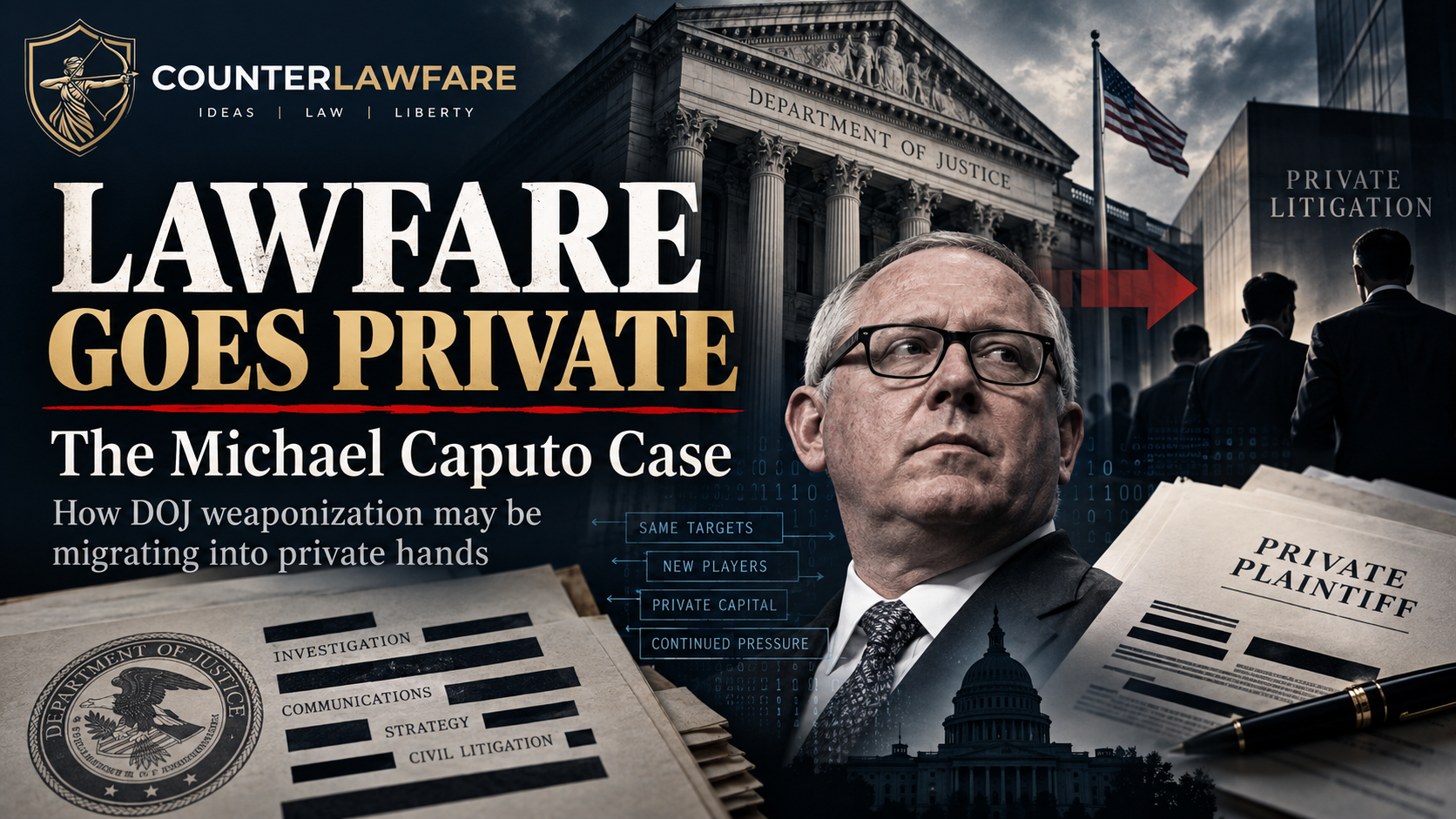
The Counterlawfare Institute does not ordinarily concern itself with contract disputes.
People sue one another every day over consulting agreements, unpaid invoices, disputed obligations, and allegations of nonperformance. Courts exist to sort those disputes out. Whatever one thinks of the merits of any particular case, an ordinary breach-of-contract lawsuit is not lawfare merely because one side believes the other is wrong.
That is precisely why the new lawsuit against Michael Caputo caught our attention.
On its face, the case is a relatively modest $100,000 contract dispute involving work Caputo performed for Gilbert Hyatt, an elderly former client of his consulting firm. Were that all there was to it, the Counterlawfare Institute would have no reason to be interested.
But that is not all there is to it.
The complaint runs some 85 pages, which is an extraordinary length for what is supposedly a run-of-the-mill $100,000 contract dispute. Rather than focusing on the alleged contractual breach, it is saturated with “Russia, Russia” allegations and innuendo, recycling the same narrative that has been used against Caputo for the better part of a decade.
First came the Mueller Special Counsel operation. Then came years of investigation by the Biden DOJ, an investigation that astonishingly remained alive even after Trump returned to office. Now, after all of that produced no charges of any kind against Caputo, the same Russia narrative has resurfaced in a private civil lawsuit supposedly about a consulting contract. Reading it as a lawyer, I found myself asking a basic question: where is the contract case?
The unusual nature of the filing becomes more interesting because of who signed it.
Hyatt’s lawyer, indeed the sole lawyer to have signed the filing, is Jack Korba, formerly an Assistant U.S. Attorney in the District of Columbia. Korba worked in the National Security Section of that office, the small unit that ran the years-long federal investigation into Caputo, as well as his documentary, The Ukraine Hoax.
There is an important limitation here. We do not presently know what role, if any, Korba personally played in the investigation of Caputo. The names on the relevant government documents remain redacted. Caputo believes Korba was involved and is seeking records that he says may resolve that question.
What we do know from the secret search warrant, which Caputo finally obtained years later and only after considerable effort, is that the office in which Korba worked at DOJ had access to an extraordinary sweep of Caputo’s digital life, including his emails, search history, YouTube activity, location data, calendar, and other information tied to his Google accounts. In other words, the government had access to an intimate record of virtually everything Caputo did online. And after years of investigating him with all the powers and resources of the federal government at its disposal, it still brought no charges against him.
Korba left DOJ in 2025 and entered private practice, where he is now representing a former Caputo client in a lawsuit that bizarrely resurrects the same false Russia allegations and insinuations that followed Caputo through years of federal lawfare.
That does not, by itself, establish misconduct. But it raises a much larger and more troubling question:
What happens when lawfare leaves government?
For years, the conventional model of lawfare has operated through a loosely defined ecosystem in which lawfare activists, the media, and government officials each play different roles. Allegations often originate outside government, migrate into official investigations, and are then supercharged by media coverage that gives them the imprimatur of government action. That coverage is subsequently recycled back into the system to justify still more investigation, litigation, and publicity, creating a vicious and self-perpetuating loop.
The Counterlawfare Institute is the first organization dedicated to systematically studying, documenting, and exposing that model.
But government power has limits. Administrations change, political priorities shift, prosecutors leave office, statutes of limitation expire, and investigations eventually close. The bureaucratic machinery may finally stop pursuing a target. The individuals who participated in that machinery, however, do not simply disappear.
They move into law firms, advocacy groups, consulting companies, universities, nonprofits, political organizations, and other private institutions. They take with them professional relationships, specialized knowledge, institutional experience, and sometimes an intense personal familiarity with the people and matters they encountered while exercising government power.
That creates the possibility of something the Counterlawfare Institute intends to study closely: privatized lawfare.
The danger is not simply that a former government lawyer might later represent a private client. That happens constantly and is a normal feature of legal practice. Nor is the concern that someone who once worked for the government must forever be prohibited from litigating matters involving people who may have been targeted by lawfare.
The concern arises when the machinery of government targeting appears capable of surviving the government action itself. A lawfare campaign that can no longer be pursued through subpoenas, search warrants, grand juries, federal investigators, or prosecutors may potentially be continued through privately financed litigation. The coercive instrument changes, but the target remains the same.
Indeed, privatization could solve one of lawfare’s recurring structural problems from the perspective of those who practice it. Government officials engaged in lawfare eventually encounter elections, supervisors, statutes, evidentiary standards, Freedom of Information law, inspectors general, judicial oversight, and changing administrations. A privately funded campaign can be much more durable.
Again, none of this establishes that this is what happened in Caputo’s case. That is precisely why the Institute is interested in following the evidence rather than outrunning it.
Caputo has filed a bar complaint setting out his allegations. He is seeking additional government records. Judicial Watch has also pursued records concerning the DOJ investigation of which Korba may have been a part. Unfortunately, the relevant names remain redacted. More information may eventually establish a connection, or it may establish that the apparent connection is less significant than Caputo believes.
Either result is useful.
Our interest is not in transforming every private lawsuit involving a former government employee into a conspiracy. It is in identifying institutional patterns before those patterns become normalized.
Caputo’s experience is particularly striking because of what preceded it. He spent years under the shadow of Russiagate investigations. The financial effects on him were catastrophic, but the effects on his family were far worse, with Caputo saying that the extraordinary stress ultimately caused his cancer. He thought those years of terror were over, but now they appear to be here again in the form of privatized lawfare.
While we are waiting to find out more about this specific case, with Judicial Watch engaged in trying to unredact the names of the people who pursued Caputo in government, the broader lesson is that lawfare cannot be understood merely by cataloging prosecutions and government investigations. It must be studied as a system of people, institutions, incentives, money, information, and methods. If those methods can migrate from public power into privately financed litigation after government action ends, then the phenomenon has entered a new phase.
Counterlawfare exists to document these cases, expose the machinery behind them, and help the victims forced to endure them. Please support our work by donating at here.