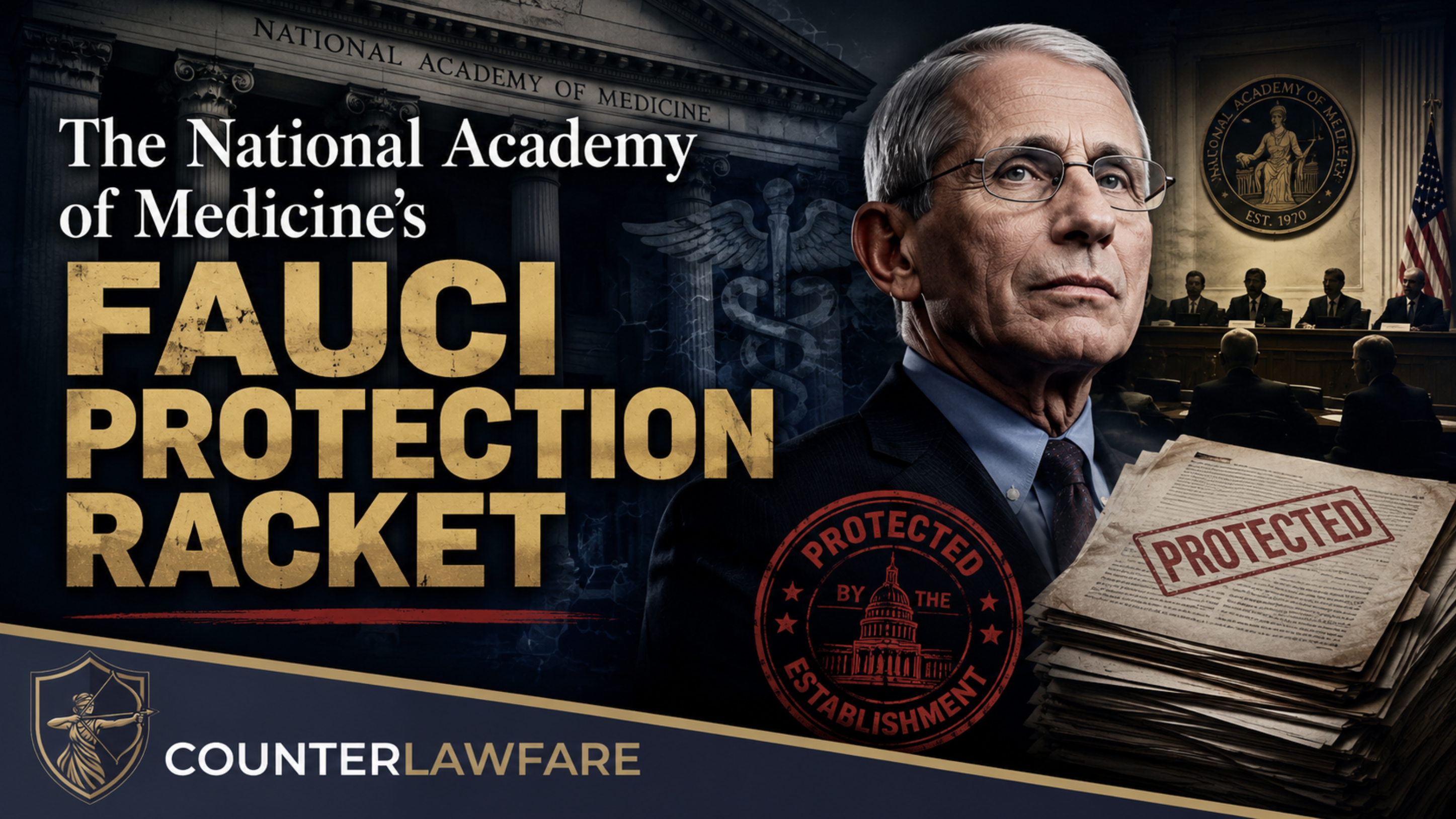
Monica Bertagnolli has been president of the National Academy of Medicine for barely a month, and she has already offered a remarkable demonstration of how institutional lawfare works.
Bertagnolli, the former director of the National Institutes of Health under Joe Biden, began her six-year term as NAM president on July 1. The Academy describes itself as an independent body providing authoritative advice on medicine, science, and public policy. She has now used that position to publish an extraordinary plea for Anthony Fauci following his invocation of the Fifth Amendment before Congress. Her statement presents itself as a defense of science. In reality, it is a defense of Fauci from accountability.
Bertagnolli opens with an elementary lecture on the scientific method: scientists formulate hypotheses, examine evidence, revise conclusions, and follow the facts wherever they lead. She then proceeds to write a long statement about Fauci while avoiding every piece of evidence that prompted Congress to investigate him in the first place. She does not grapple with the discrepancies between his private communications and his public statements. She does not examine the extraordinary behind-the-scenes cover-up surrounding the origins of the Covid virus, or ask whether his public certainty on contested questions was justified by what he privately knew. She does not confront the government's own role in shaping the supposedly independent scientific consensus later invoked to marginalize the laboratory-origin hypothesis. Instead, she simply declares that Fauci "has not been shown to have acted negligently in his scientific judgments."
Bertagnolli’s claim is not merely tendentious. It is false. There is a huge documentary record showing that Fauci’s public statements did not match what he knew privately. That is troubling enough on its own. It is more troubling still when such a false assertion is made under the authority of a tax-exempt scientific institution.
Turning Accountability Into Persecution
Worse, Bertagnolli systematically inverts the roles of the powerful and those trying to hold them accountable. She recasts the entire congressional effort to scrutinize Fauci as something disreputable, blurring legitimate questions about his conduct with “conspiracy theories” and portraying the proceedings themselves as politically motivated “theater.” And Fauci, who directed one of the most powerful biomedical agencies in the world for nearly four decades, is recast as the courageous scientist suffering for having spoken uncomfortable truths to power.
Except Fauci was power. He wielded so much of it that he eventually declared, “I represent science.” Yet when Congress examines his conduct, Bertagnolli would have us believe that the danger lies principally in the examination.
Her central argument is the most revealing part of her statement. Subjecting officials like Fauci to hearings, subpoenas, and legal consequences, she warns, will frighten talented scientists away from government service. Consider what that proposition actually entails. If scrutinizing a powerful official might make other officials uncomfortable, scrutiny should apparently be restrained. If subpoenas might discourage scientists from entering government, then issuing subpoenas becomes dangerous. If legal accountability might make public service less attractive, then legal accountability itself becomes a threat to science.
What Is the Charitable Purpose?
This is, in effect, an immunity doctrine for senior bureaucrats. No serious system of public accountability could operate on such a principle. Yet one of America's premier medical institutions treats the argument as profound.
The Counterlawfare Institute has asked the National Academy of Medicine to explain itself.
In an inquiry sent to NAM, the Institute asked what specific charitable, scientific, or educational purpose is furthered by using the Academy's institutional authority to defend Fauci in an active congressional dispute and to characterize congressional scrutiny of him as politically motivated.
NAM operates within the National Academies' tax-exempt structure, and while Section 501(c)(3) organizations may engage in public-policy advocacy and limited lobbying, their resources must principally further their exempt charitable, educational, or scientific purposes.
Bertagnolli's statement therefore raises a more fundamental question: what legitimate basis does the National Academy of Medicine have for using its institutional authority to shield Anthony Fauci from congressional scrutiny?
For the avoidance of doubt as to whether Bertagnolli was acting in her capacity as president of NAM, she published the statement on LinkedIn, a professional platform centered on employment and institutional affiliation, where the article itself identifies her as president of the National Academy of Medicine. Just two weeks earlier, she had opened her previous LinkedIn article with the words, “As the newly inaugurated president of the NAM,” before discussing what she hoped to accomplish in that role and what the Academy should do. Her writing there is therefore plainly not that of a private citizen commenting on current affairs. She is writing as NAM’s newly installed president, with the authority and prestige of that office behind her.
Institutional Lawfare
Whatever answer comes back from NAM, the episode belongs to a broader and more pernicious pattern. Institutional lawfare has flourished precisely because it rarely looks like lawfare at all. It arrives instead in the language of expertise, neutrality, professionalism, and institutional responsibility, delivered by purportedly highly respected organizations, which present their interventions not as exercises of power but as neutral judgments handed down from somewhere above the political fray.
That is what makes the practice so effective. A powerful institution can intervene on behalf of a favored figure, discredit his critics, and declare scrutiny of him illegitimate, all while presenting itself as the disinterested guardian of scientific standards.
And because this behavior has gone largely unchecked for years, the institutions engaging in it have learned that there is no cost, only benefit.
When tax-advantaged organizations use their institutional resources to influence democratic processes such as congressional inquiries or votes, the public deserves to know what resources were used, who authorized the intervention, whether lobbying rules were implicated, and how the activity serves the organization’s stated charitable purpose. Their conduct should be documented, examined, and, where appropriate, subjected to legal and regulatory scrutiny.
That is exactly the work the Counterlawfare Institute was created to do.
We do not merely identify episodes like this and move on when the news cycle does. We examine the institutional and legal structures behind them, educate the public, and pursue accountability.
You can support our work at counterlawfare.org/donate.