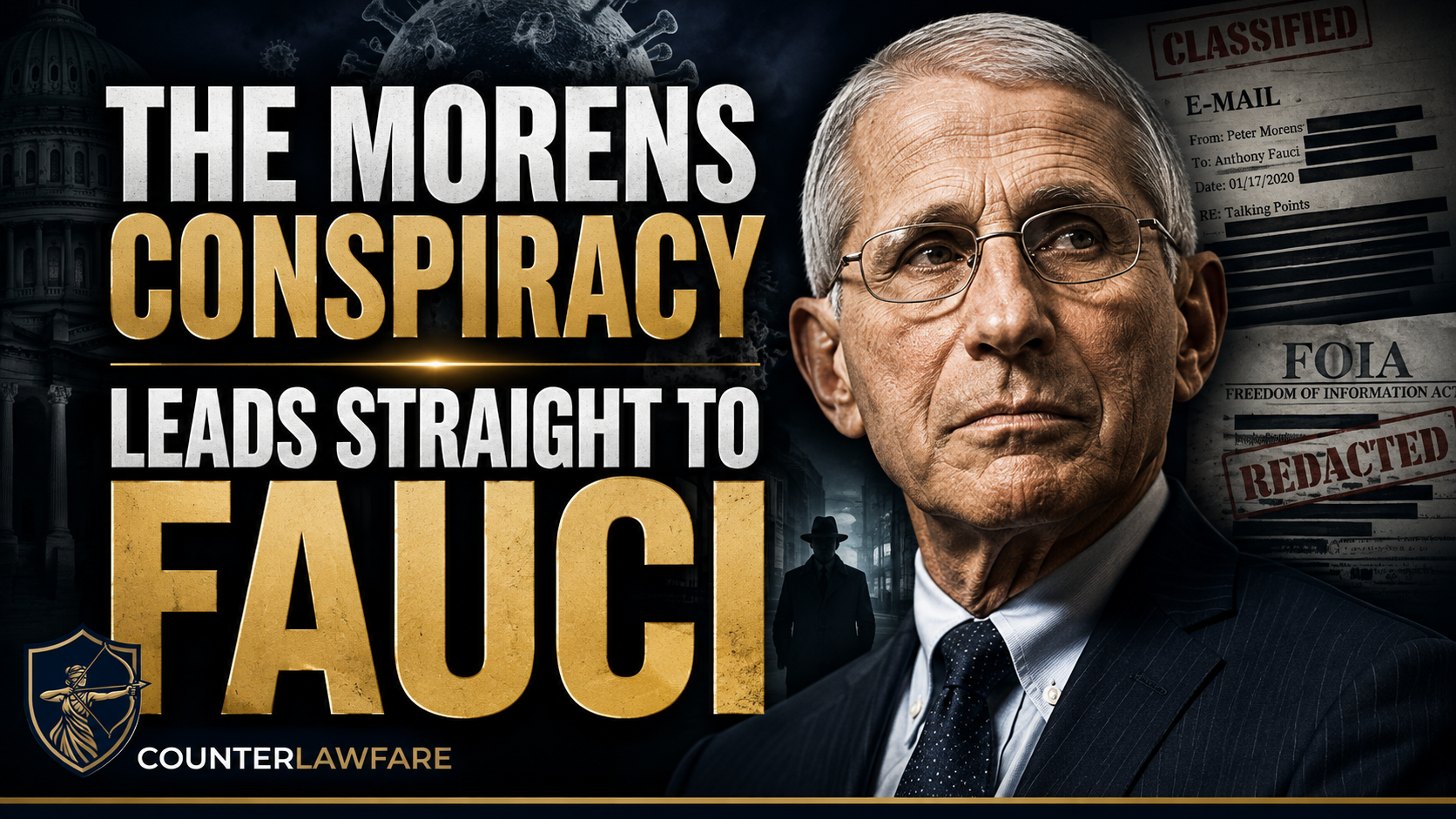
You may have seen the news this week that David Morens, Anthony Fauci’s longtime senior adviser at the National Institute of Allergy and Infectious Diseases, pleaded guilty to conspiracy to defraud the United States over his efforts to conceal federal records during the Covid pandemic. In his plea agreement and stipulated statement of facts, Morens admitted conspiring with two other individuals whose descriptions identify them as Peter Daszak, the former president of EcoHealth Alliance, and Gerald Keusch of Boston University. Neither man has been charged.
Even just on its own, this is a remarkable development. For years, we have been looking at emails showing officials hiding communications, circumventing FOIA, and coordinating behind the scenes over the origins of Covid. Now one of the people at the center of those communications has actually pleaded guilty to conspiracy.
But Morens is only the doorway into the story.
If you want to understand what this episode is really about, the person to focus on is Anthony Fauci, and the place to begin is an EcoHealth Alliance grant.
The Grant at the Center of Everything
That grant is the spine of the entire Covid origins scandal. In 2014, while Anthony Fauci was director of NIAID, his institute awarded Peter Daszak’s EcoHealth Alliance grant R01AI110964, formally titled Understanding the Risk of Bat Coronavirus Emergence. It connected Fauci’s NIAID to Peter Daszak, EcoHealth Alliance, Shi Zhengli, the Wuhan Institute of Virology’s leading bat-coronavirus researcher, widely known as China’s “Bat Woman,” and the Wuhan Institute itself. It helped finance the coronavirus research program in Wuhan and, perhaps most importantly, helped integrate the Wuhan lab into an elite Western research network that gave it access to advanced techniques, expertise and scientific legitimacy. That included collaboration with Ralph Baric at the University of North Carolina, one of the world’s leading coronavirus researchers and a pioneer of the reverse-genetics techniques used to manipulate coronaviruses, whom the U.S. Department of Health and Human Services has since defunded over what it called a “pattern of deception.”
This is why the fight over EcoHealth was never simply about whether one nonprofit should continue receiving federal money. Pull hard enough on the EcoHealth thread and you reach the research itself, the Wuhan laboratory, the American scientists collaborating with it, the NIH officials overseeing the work, and the question that haunted Fauci from the first days of the pandemic: could the new virus have emerged from exactly this world of coronavirus experimentation?
Fauci Immediately Saw His Own Exposure
We know how quickly Fauci’s mind went there because we have his February 1, 2020 email.
Late on January 31, Kristian Andersen, an evolutionary biologist at Scripps Research who would soon become one of the principal authors of the fraudulent Proximal Origin paper, produced at Fauci’s instigation to dismiss the possibility of a laboratory origin, told Fauci that some features of SARS-CoV-2 appeared inconsistent with what he expected from evolutionary theory. A few hours later, at 7:29 a.m. on February 1, Fauci sent an urgent message to his deputy Hugh Auchincloss. The subject line was “IMPORTANT.” Fauci told him they needed to speak that morning and that Auchincloss would have “tasks today that must be done.”
Attached was the 2015 Nature Medicine paper by Ralph Baric, Shi Zhengli and their collaborators. The filename Fauci was looking at could hardly have been more revealing: “Baric, Shi et al - Nature medicine - SARS Gain of function.pdf.”
That paper grew out of the early Baric-Shi collaboration and was supported by multiple NIAID grants while Fauci ran the agency. In the experiment, researchers constructed a chimeric SARS-like coronavirus and demonstrated its ability to infect human airway cells. Shi’s participation was separately supported through Daszak’s EcoHealth Alliance. The experiment therefore already brought together the same central players who would later sit at the heart of the Covid origin saga: Fauci, Baric, Shi, and Daszak.
So when Fauci was confronted with the possibility that Covid might have been engineered, his first reaction was not to investigate, warn the public, or reassess the public-health response. It was to protect himself. He immediately traced the threat back to the research network his own agency had brought about and began dealing with the exposure it created for him and NIAID.
That is the context people need before they hear a single word about David Morens.
By the spring of 2020, President Trump had caught wind of the lab-origin discussion that Fauci and much of the media were working to bury. He wisely moved to terminate EcoHealth’s bat-coronavirus grant, immediately exposing the entire chain to scrutiny: what EcoHealth had funded, what the Wuhan Institute had done, what Fauci and the NIH knew, whether EcoHealth had complied with its grant requirements, and why American taxpayer money had supported this kind of research in the first place.
When the Machinery Went Into Overdrive
According to the stipulated facts accompanying his plea agreement, between April 2020 and June 2023 Morens conspired with Daszak, Keusch and others to help restore the EcoHealth grant and counter the lab leak narrative. Keusch, an infectious disease expert at Boston University and longtime ally of Daszak, was not merely copied on the correspondence: according to prosecutors, he joined Morens in pledging to help Daszak get the grant restored and counter the lab-leak narrative. Because they expected their communications to become the subject of FOIA requests, they moved those discussions onto Morens’s personal Gmail account. They used this back channel to push natural origin, restore EcoHealth’s funding, and bury the problems threatening their entire enterprise.
This is where the Morens case becomes such a powerful example of what we at the Counterlawfare Institute have been calling institutional lawfare. Institutions can exercise political power through grants, bureaucratic procedures, academic authority, scientific journals, professional prestige and control over information. Those tools often appear neutral because they are wrapped in the language of administration, expertise and process.
The Morens affair gives us an unobstructed view inside that machinery. Here was an elected President who had terminated EcoHealth’s grant amid growing concern about the Wuhan research and demanded answers about how American taxpayer money had been used. Congress, the press, and the public were entitled to examine that decision, the underlying research, and the conduct of the agencies involved. Instead, officials inside NIH worked behind the scenes to protect EcoHealth, restore its funding, shape the narrative, and move sensitive communications beyond the reach of FOIA. That is institutional lawfare: using the machinery of unelected institutions to circumvent democratic process, override political accountability, and impose outcomes the public never authorized.
The Trail Leads to Fauci
Most importantly, sitting above Morens throughout this entire saga was Anthony Fauci.
The email trail puts it beyond doubt that Morens was not running some private operation of his own while Fauci remained unaware. In April 2020, just after EcoHealth’s grant was terminated, Morens wrote to Daszak that “Tony is now fully aware” and, according to what Morens had been told, was involved in “some sort of damage control.” Morens described the objective explicitly: to get through the controversy with minimal damage to Daszak, his colleagues, NIH, and NIAID.
That email captures the institutional scandal in miniature. The people responsible for overseeing the research were also thinking about how to protect the people, grants and agencies under scrutiny.
Morens explained in an April 2021 email to Keusch and Daszak that sensitive material could reach Fauci through Fauci’s private Gmail account or simply be handed to him personally. In a May 2021 email to Keusch and Daszak, Morens referred to a “secret back channel” to Fauci. When Congress questioned Morens about his relationship with Fauci, he explained that he could walk into Fauci’s office whenever he wanted and had face-to-face meetings with him “all the time.”
By October 2021, the emails were even more explicit. After Morens had spoken with Fauci, Keusch reported to Daszak that even messages sent through Gmail on Morens’s cell phone could still be subject to FOIA, adding, “This came from Tony in their conversation this morning.” Keusch then told Daszak that “Tony has told him not to be in touch with you and EHA [EcoHealth Alliance] for the time being.” Yet the communication was not actually going to stop. Keusch immediately explained how the connection would be preserved, writing that Morens “will stay connected to me and via me to you.”
The significance of that is hard to overstate. Fauci was personally discussing the FOIA exposure of Morens’s private communications and instructing him to stop direct contact with Daszak and EcoHealth. Keusch, who was outside the federal government, served as the intermediary through whom that contact continued. He was particularly well placed to do so. The Boston University infectious-disease expert had received NIAID support going back decades and had served for five years as director of NIH’s Fogarty International Center.
In another email from the same period, Morens wrote directly to Daszak, with a copy to Keusch: “Peter, from Tony's numerous recent comments to me, and from what Francis has been vocal about over the past 5 days, they are trying to protect you, which also protects their own reputations.” In other words, Morens was explicitly telling Daszak that Fauci and then-NIH Director Francis Collins were trying to protect him because their own reputations were tied up in the same scandal. Morens also discussed his conversations with Fauci about EcoHealth, while the surrounding correspondence shows information and instructions moving back through the same network.
Fauci testified under oath in June 2024 that he “knew nothing of Dr. Morens’s actions regarding Dr. Daszak, EcoHealth, or his emails.” The contemporaneous record tells a radically different story. The emails place him inside the operation itself, repeatedly briefed by Morens, discussing Daszak and EcoHealth, communicating his views and interventions through intermediaries, and accessible through private channels designed to keep their discussions away from government email systems.
Morens has now admitted that his hidden Gmail account was used as a back channel to “Senior NIAID Official 1,” i.e. Fauci. In other words, the back channel to Fauci is part of the conspiracy Morens has now admitted in federal court.
Once you understand that, the idea that this case is really about Morens collapses. Fauci sat at the center of it all, and the emails show that he was fully aware of, and actively supported, what Morens was doing.
What They Were Really Protecting
That is also why the EcoHealth grant is so important. Without that context, the Morens prosecution can be made to sound like a grubby Washington story about an official abusing Gmail to help a friend get his grant back. Once the history is restored, you see what was actually at stake.
The grant funded the research network that immediately alarmed Fauci when the possibility of a laboratory origin arose. It tied American public-health institutions directly to coronavirus research in Wuhan, and scrutiny of that relationship threatened the careers, reputations, and judgment of the people who had approved and overseen it, with the possibility of far more serious civil or criminal exposure if the pandemic could be traced back to research they had funded or facilitated. When that scrutiny arrived, people inside the same institutional network began coordinating privately to protect EcoHealth and themselves, above all by driving the natural origin narrative. If Covid came from nature, then nothing Fauci, Daszak, Baric, and the rest had funded, approved, or enabled, could have caused the pandemic. They could not afford to leave even an accidental lab leak caused by the Chinese on the table, because every road out of the Wuhan lab ultimately led back to them.
There is even a detail in Morens’s guilty plea that captures how badly the boundaries had broken down. Daszak sent Morens wine to thank him for his “behind-the-scenes shenanigans.” Morens then discussed something he could do to deserve the gift: write a scientific commentary in a prominent medical journal arguing that Covid had natural origins. Daszak also dangled meals at Michelin-starred restaurants.
Think about how grotesque this is. Morens, a senior government official, was discussing using his scientific standing to publish a supposedly authoritative article arguing that Covid had a natural origin as a favor to Daszak, whose own Wuhan work sat at the center of the lab origin question. And all along, it was mainly about protecting Fauci. The scientific establishment had become little more than a protection racket.
This is why describing the episode as a FOIA scandal misses almost everything important about it. FOIA evasion was the concealment mechanism. The deeper operation was institutional protection: protecting EcoHealth, the funding relationship, the people who had overseen the work, and the preferred account of Covid’s origins from scrutiny that threatened all of them at once.
At the same time, the public was being presented with a very different picture. Scientific papers and statements increasingly portrayed a natural origin as the authoritative position. Media organizations amplified that supposed consensus, and technology platforms relied on public-health authorities and the scientific establishment to decide which claims could be suppressed as misinformation.
Morens Cannot Be the End of the Story
The danger now is that Morens becomes a convenient endpoint, allowing this to be remembered as the prosecution of one official who violated federal records laws while everyone above him disappears from the story.
In truth, the emails repeatedly lead upward to Fauci. They lead to his awareness that the Covid origins question threatened to expose his own role in funding and enabling the research, to his involvement in the EcoHealth crisis, to his communications with Morens, and to the private routes used to reach him outside normal government channels.
That is exactly why the Morens case deserves to become a central example in our understanding of institutional lawfare. The machinery works through institutional authority and dispersed responsibility, which makes the larger operation difficult to see while it is happening and easy to fragment once it is exposed.
Morens’s guilty plea has finally cracked open part of that system, and we should welcome the fact that someone has at last been held accountable. But Morens cannot be allowed to absorb the scandal. His conviction should be the beginning of the reckoning, not a convenient substitute for uncovering what actually happened.
The trail begins with the coronavirus research, runs through EcoHealth and Wuhan, passes directly through Morens’s concealed communications, and leads into the office of the man who ran NIAID throughout the entire episode: Anthony Fauci.
If you value this kind of deep-dive research, please consider supporting the Counterlawfare Institute.