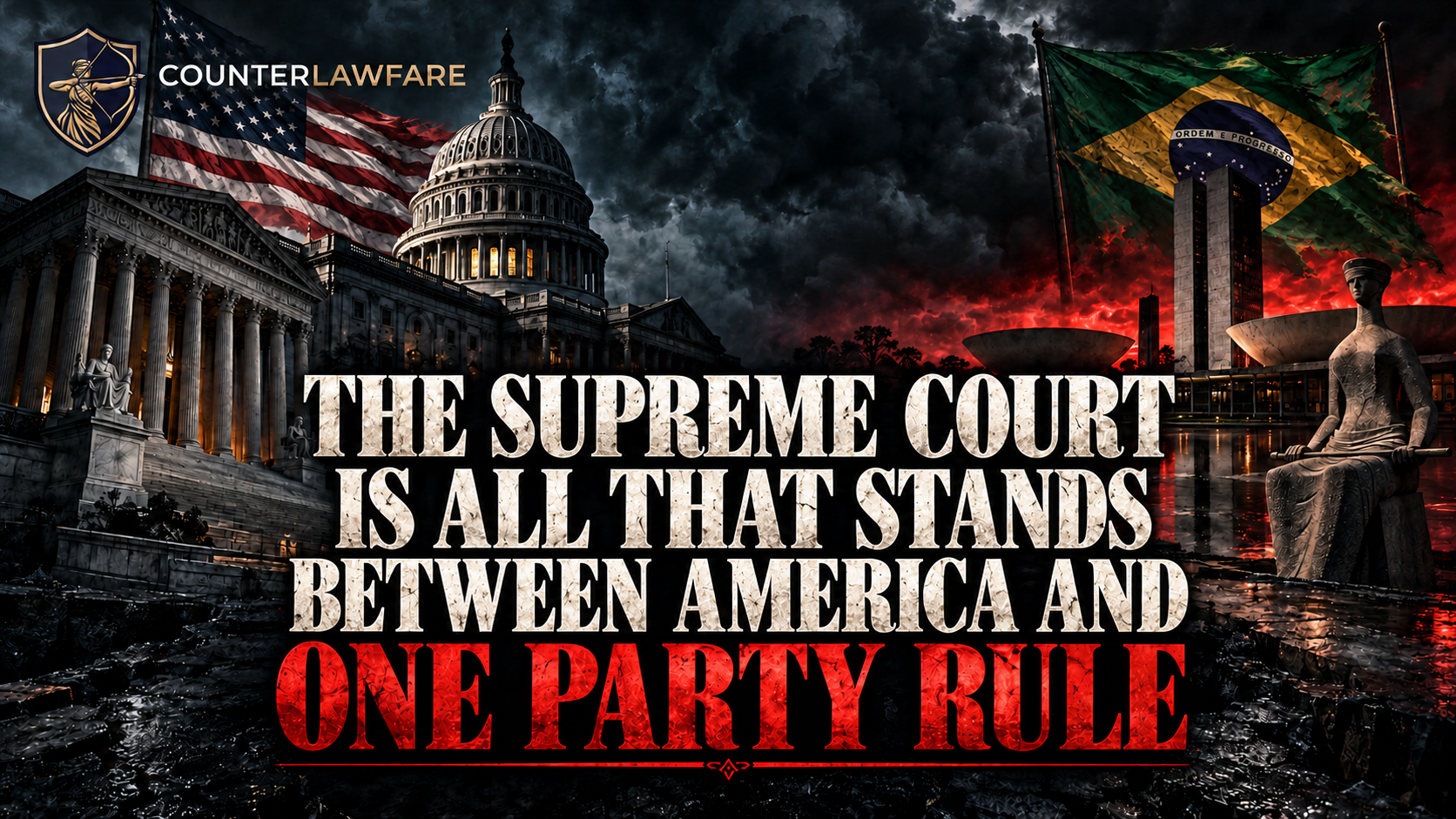
Brazil offers a chilling preview of what happens when lawfare is allowed to run to its logical conclusion, producing de facto one party rule while preserving the outward appearance of democracy. At the center of that transformation has been Brazil's Supreme Court, which has intervened directly in electoral politics and has used its judicial authority to silence and marginalize the opposition. In America, the Supreme Court remains the last major obstacle to the lawfare machinery achieving the same degree of institutional control. Its capture would remove the final major constitutional barrier to America following Brazil down the same path.
For years, there has been relentless lawfare against the Bolsonaro family and the wider conservative movement. Jair Bolsonaro won Brazil's 2018 presidential election, surviving an assassination attempt during the campaign, and governed the country from 2019 to 2022. After disputing his 2022 election defeat to Luiz Inácio Lula da Silva, the left-wing former president who returned to power in 2023, Bolsonaro was barred from running again, convicted of plotting a coup, and sentenced to more than 27 years in prison, a sentence he is currently serving.
Had Democrats succeeded in the campaign they unleashed against Donald Trump following the 2020 election, America would now be looking at much the same picture, with Trump behind bars rather than back in the White House. This is no hyperbole. In 2024, the Supreme Court reversed a ruling disqualifying Trump from Colorado's presidential ballot and overturned lower court decisions rejecting his claim of presidential immunity, imposing constitutional limits on Jack Smith's federal prosecution. Had the lawfare campaign continued, the Supreme Court would likely have remained the final constitutional safeguard against further efforts to take Trump off the political board.
Imagine Donald Trump spending the 2024 presidential election in prison while one of his children ran in his place. That is what happened in Brazil this year, with Jair Bolsonaro behind bars and his son Flávio winning the first round of the presidential election and entering the runoff as the heavy favorite. But there was no fairy tale ending. He lost to Lula in another bitterly disputed election.
On election day, a Supreme Court justice who had previously served as Lula's personal lawyer, and whom Lula himself had appointed to the Court, ordered a nationwide extension of voting hours following a request from Lula's campaign concerning problems in regions where he enjoyed strong support. While many factors shaped the election's outcome, the Supreme Court's intervention showed once again how readily Brazil's judiciary could move the goalposts, even on election day itself.
According to Flávio, judicial restrictions were imposed against him just seven minutes after the results were announced. He was subsequently barred from leaving Brazil and ordered to surrender his passports. Nevertheless, he escaped through Argentina and Ecuador and reached the United States, where he now is.
While the current wave of lawfare in Brazil is directed overwhelmingly against conservatives, Lula himself was imprisoned in 2018 and prevented from running in that year's presidential election. He spent almost two years in prison before being released, and his convictions were subsequently overturned, allowing him to return to power in 2022.
Whatever one thinks of the charges, both against Lula and the Bolsonaros, the fact that Brazil's current president and his immediate predecessor have both been imprisoned and barred from running for president at different times shows how thoroughly lawfare has permeated the country's political system. Brazil has reached the endpoint of lawfare. Whoever controls the courts determines the outcome of elections.
The Real Purpose of Lawfare
For years, Americans have been misled into believing that lawfare is essentially a series of legal cases brought against one man, Donald Trump, and a few of his associates. What is not yet widely understood is that Democrats and their allies have been building a much broader machinery of political control, using Trump as the justification. That machinery is designed to outlast Trump and operate regardless of who occupies the White House. Ultimately, lawfare has as little to do with Trump personally as it does with the Bolsonaro family in Brazil.
The strategy works in several ways. The first objective is to prevent the opposition from winning elections. The Clinton campaign's “Swiftboat Project,” which ultimately developed into Russiagate, was designed to derail Trump's bid for the presidency. The battles over election rules and procedures in 2020, the subsequent attempts to remove Trump from the ballot, and the manipulation of electoral competition through the courts all serve the same objective.
The recent scheme in Alaska is another illustration of this approach. Operatives aligned with Democratic Senate candidate Mary Peltola's campaign sought to recruit another candidate named Dan Sullivan to run against incumbent Republican Senator Dan Sullivan, hoping to confuse voters and siphon votes away from him. The effort involved the Elias Law Group, founded by Marc Elias, whose previous law firm played a central role in the Clinton campaign's operation against Trump.
When these efforts fail and Republicans win elections anyway, the objective shifts to sabotaging their administrations and preventing them from governing effectively. That is precisely what happened during Trump's first term, when he was relentlessly hounded by the fabricated Russia collusion scandal, which also engulfed his associates, including Michael Flynn, who was taken off the political board. During his second term, Trump's administration has faced nearly 1,000 lawsuits challenging its policies and tying up its agenda in the courts. His appointees have also been targeted personally, including Ed Martin, who has faced efforts to revoke his law license. The aim is to frustrate the administration at every turn, making it as difficult as possible for a president to carry out the policies voters elected him to implement.
And Republicans are hardly the only targets. Robert F. Kennedy Jr. experienced the same tactics when he challenged Joe Biden in 2024 and subsequently ran as an independent. Democratic Party operatives fought to keep him off presidential ballots. Then, when Kennedy endorsed Trump, the Democratic lawfare machinery suddenly reversed course and began fighting to keep him on the ballot.
Here was the same man running in the same election, facing the same lawfare machinery, yet the tactics were turned completely upside down depending on whether Kennedy was running against Biden or supporting Trump.
In a September 2026 speech at the Republican Midterm Convention, Kennedy described how similar efforts had targeted Democrats who challenged Biden, including Dean Phillips and Marianne Williamson, as well as independent candidate Cornel West. Kennedy recounted being sued in twelve states to remove him from ballots, only to face further legal battles over his efforts to withdraw after endorsing Trump.
The lawfare machinery extends far beyond party operatives like Marc Elias. It reaches into the permanent bureaucracy, intelligence agencies, prosecutors' offices, regulatory authorities, media organizations, universities, and professional bodies, including bar associations. These institutions wield different forms of power, but together they can obstruct elected administrations, frustrate their policies, and intimidate or punish those willing to serve them.
The ultimate objective is to establish a system in which one party can prevent its opponents from winning elections or, when that fails, prevent them from exercising the power voters have given them.
In principle, lawfare can be wielded by either side. In practice, however, Republicans have nothing resembling the institutional lawfare apparatus deployed against them and remain far behind in recognizing and confronting the full extent of the threat.
The Supreme Court Is the Missing Piece
The Supreme Court is the principal missing piece in this system of institutional control. It is the one institution the lawfare machinery has not yet captured, although the vicious smear campaign and intimidation directed at Brett Kavanaugh may already have had some effect, both on him and on other justices who have seen what happens when they become lawfare targets. The 2022 assassination plot against Kavanaugh further exposed the danger that threats and intimidation can influence judicial thinking and decisions.
For now, the Supreme Court remains the most powerful constitutional check on the machinery of lawfare, with the authority to restrain abuses of legal and governmental power, whether carried out through criminal prosecutions, civil lawsuits, regulatory proceedings, or other means.
That is why Democrats have repeatedly pushed to expand the Court and change its composition. Control of the Supreme Court would remove the main remaining obstacle to using the full power of those institutions against political opponents, setting America on the same path toward de facto one party rule that Brazil has already taken.
Americans often imagine one party rule as something that arrives through an obvious constitutional rupture, such as the cancellation of elections. But lawfare works differently. It achieves the same result gradually, without any dramatic event that would alert the public to what is happening.
Elections still take place, as they do in Brazil. People still debate politics, opposition parties still exist, and outwardly everything looks like a functioning democracy. Beneath the surface, however, the conditions under which political competition takes place are steadily eroding.
It is the familiar story of the frog in slowly heating water, with each development appearing isolated and unrelated to everything else. The Alaska scheme looks like some peculiar episode in a Senate race, overlooking the involvement of Marc Elias, one of the godfathers of lawfare. The relentless lawsuits against Trump's administration look like routine legal disputes over executive action, overlooking the recurring involvement of the same lawfare operatives and the cumulative damage those lawsuits inflict on his ability to govern. The media's incessant attacks and falsehoods look like Trump Derangement Syndrome, overlooking the media's integral role in the wider lawfare machinery.
And that is the bigger picture. Lawfare is a system comprising many interconnected parts, each reinforcing the others. Through hundreds of individual actions that attract little attention on their own, the machinery gradually consolidates institutional power while depriving the opposition of its ability to compete, govern, and ultimately challenge those who control it.
The process continues regardless of electoral outcomes. Voters may elect a president, only to find that the institutions necessary to carry out his policies remain hostile, that qualified people are afraid to serve him, and that legal retaliation hangs over anyone willing to help him govern. The formal transfer of political power may still take place, while much of the practical power remains in the hands of those who control the institutions.
By the time one party control is sufficiently entrenched for everyone to recognize it, the institutions needed to reverse it may already have fallen under the control of the lawfare machinery, as has happened in Brazil.
The Supreme Court is the last major obstacle standing in the way of that outcome in America. If it too falls under the control of the lawfare machinery, the final constitutional safeguard against the consolidation of one party rule will be lost.