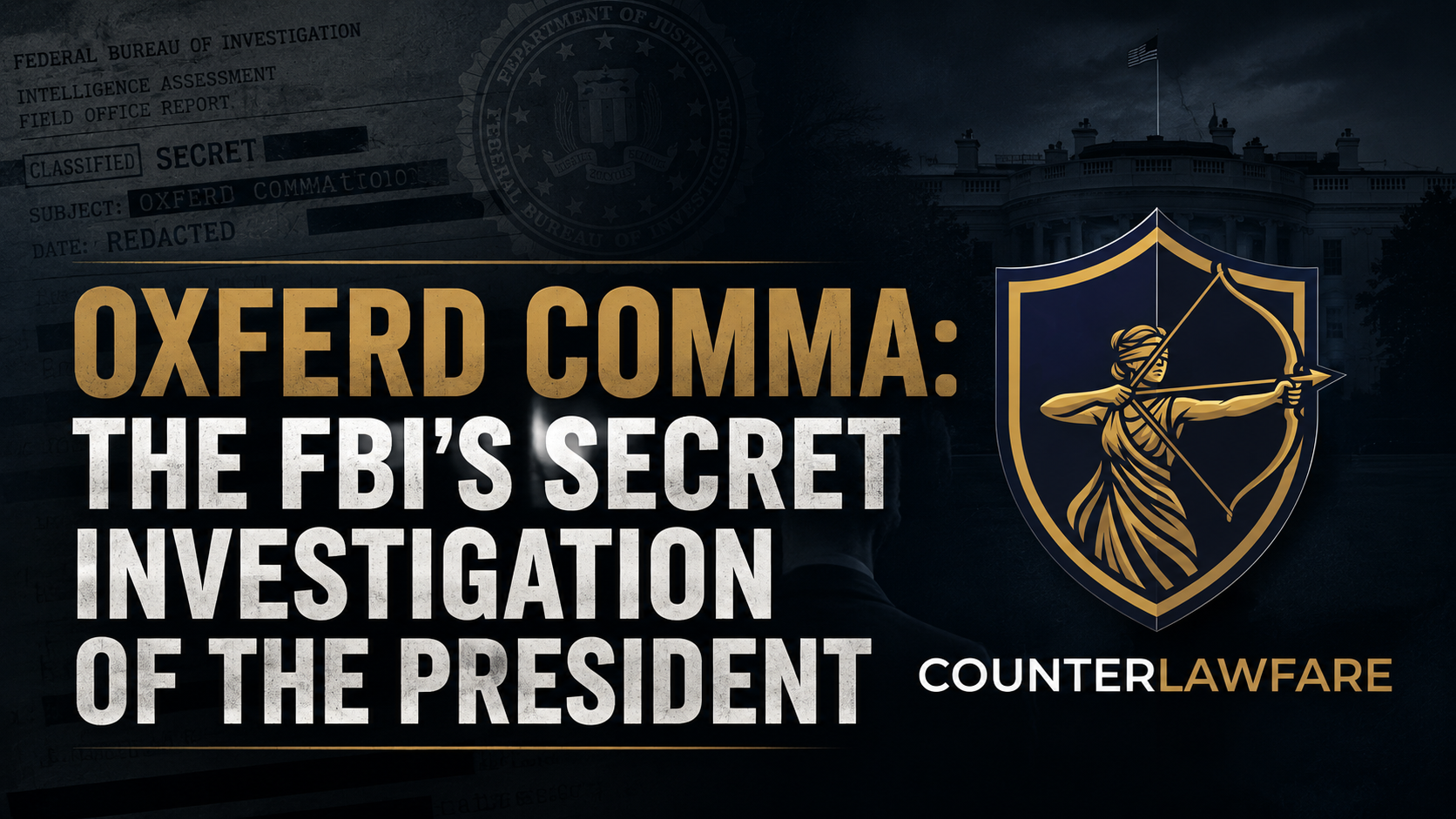
Three astounding new FBI documents released by the White House reveal for the first time the details of a secret counterintelligence investigation opened against President Donald Trump in May 2017.
The FBI called it OXFERD C0MMA.
An almost entirely redacted version of one of the documents was released in 2024. At the time, virtually everything of substance had been concealed. We could see that a case against President Trump existed, but not what it was called, precisely what the FBI was investigating or how extraordinary the investigation really was.
Now the redactions have been lifted and what they reveal is remarkable.
On May 16, 2017, the FBI opened a full counterintelligence investigation to determine whether President Trump was an agent of Russia.
The investigation went far beyond possible contacts between campaign associates and Russians or Russian assistance to the campaign. The FBI was investigating whether the sitting President of the United States was himself “directed by, controlled by, and/or coordinated activities with” the Russian Federation.
And it concealed that investigation behind the bizarre codename OXFERD C0MMA, with “Oxford” misspelled and the letter O in “Comma” replaced by a zero.
That spelling appears to have been designed to make the investigation impossible to discover through ordinary searches of FBI records, FOIA productions or other means. Anyone searching for the obvious phrase “Oxford Comma” would not find it.
The documents are astonishing for another reason. By May 2017, the FBI already knew that the Russia-collusion theory had no factual foundation.
There Was Only Ever One Predicate
Strip away everything subsequently piled onto Russiagate and Crossfire Hurricane began with one articulable fact.
In July 2016, Australian officials reported that Trump campaign advisor George Papadopoulos “suggested that the Trump team had received some kind of suggestion from Russia that it could assist this process with the anonymous release of information during the campaign that would be damaging to Mrs. Clinton (and President Obama).”
That was the predicate. There was nothing else. Some might argue that it was worth looking into despite how threadbare this “suggestion of a suggestion” was. But even if we accept that, the moment the FBI investigated it, the predicate collapsed. Yet, almost a year later, OXFERD C0MMA would again rely on the same discredited narrative about what Papadopoulos had supposedly said.
In the intervening ten months, Papadopoulos had been subjected to a honey trap, a bogus project, and a series of seemingly casual outings with an old friend who was secretly working with the FBI, all of them covertly recorded. Yet not once did Papadopoulos say anything remotely incriminating. When pressed by FBI undercover operatives, he repeatedly denied any coordination between the Trump campaign and Russia.
Even before that, the FBI had spoken to the Australians themselves. According to their accounts, later relayed by Special Counsel John Durham because the underlying FBI interview records have never been publicly released, the two Australians gave different recollections of the conversation. That discrepancy was itself a serious problem. The entire investigation rested on what Papadopoulos had supposedly said in a single conversation, yet the two people who heard it could not agree on what he had actually said. Alexander Downer, the senior official and Australia's High Commissioner in London at the time, told Durham that he disagreed with the verbatim Australian report, which had been written by the other Australian present, Erika Thompson. Downer's recollection was that Papadopoulos had said “the Russians have information” and that was all.
However, even if, for argument’s sake, we assume that the FBI proceeded purely on the basis of the Australian report, that report itself acknowledged that whatever derogatory information Russia supposedly possessed about Clinton might have been “acquired publicly,” meaning it could already have been in the public domain.
The evening before Papadopoulos met the Australians on May 10, 2016, Judge Andrew Napolitano appeared on Fox News and claimed that Russia possessed Hillary Clinton’s missing emails. In other words, there was an obvious and entirely innocent explanation for what Papadopoulos supposedly told the Australians. He may simply have been repeating something he had heard on television the night before.
The FBI also interviewed Maltese professor Joseph Mifsud, the man who allegedly told Papadopoulos that Russia possessed damaging information about Hillary Clinton. Mifsud emphatically denied that they had ever discussed anything of the kind.
By this point, the FBI had also examined Papadopoulos's communications, including extensive correspondence with Mifsud, without finding any evidence of such a conversation, coordination with Russia or anything else untoward.
But there was an even more basic problem with the story.
Mifsud supposedly told Papadopoulos on April 26, 2016 that Russia possessed thousands of Hillary Clinton's emails.
The event later used to give that conversation significance was the release of DNC emails.
Those were not the same emails.
More importantly, the DNC email archive later published by WikiLeaks had not even been exfiltrated when Mifsud supposedly described it. Special Counsel Robert Mueller's own report places the theft of the thousands of DNC emails later released by WikiLeaks between approximately May 25 and June 1, 2016, nearly a month after the alleged Mifsud-Papadopoulos conversation.
And many of those emails did not even exist on April 26. The WikiLeaks archive extends through May 25. So the supposed foreknowledge did not merely lack corroboration but the chronology itself contradicted it.
Mifsud was supposedly talking about one set of emails before the other set had even been exfiltrated, including emails that had not yet been written.
This nonetheless became the factual foundation for investigating a presidential campaign, and later the President himself.
And by early September 2016, the FBI possessed intelligence pointing in the opposite direction. On September 7, an investigative referral was sent to Director James Comey and lead Crossfire Hurricane investigator Peter Strzok concerning intelligence alleging that Hillary Clinton had approved a campaign plan to vilify Trump by tying him to Russian interference in the election. This became known as the Clinton Plan intelligence.
The FBI later had another reason to consider whether the Clinton campaign itself was generating anti-Trump narratives. Among the Podesta emails published by WikiLeaks was a February 2016 exchange in which Clinton campaign figures discussed their “Trump swift boat project” that needed to be “ready, funded and unleashed when we decide.”
The phrase was revealing because Democrats had spent years denouncing the 2004 “swiftboating” of John Kerry as a coordinated political attack, yet Clinton campaign officials were using precisely that term internally for an operation they were preparing against Trump.
The FBI Found the Opposite of What It Was Looking For
By May 2017, this was no longer simply a case in which investigators had failed to find evidence.
They had found evidence that their theory was entirely wrong. Not only was there no Trump-Russia conspiracy, by this point they possessed substantial evidence indicating that the entire collusion narrative had been concocted by Trump’s political opponent.
Meanwhile, the Steele dossier had collapsed under examination of its own sourcing. Igor Danchenko, Steele's primary sub-source, had already been interviewed and had disavowed the substance and certainty Steele had attributed to his reporting, describing much of it instead as little more than barroom gossip picked up from friends over drinks.
So the FBI Investigated the President
The proper response would have been to close the Trump investigation and turn to the Clinton campaign, including the national security implications of a presidential campaign falsely portraying its opponent as colluding with Russia. Instead, the FBI doubled down.
The newly released OXFERD C0MMA memorandum padded its lack of evidence with Trump's business dealings involving Russians, his desire for better relations with Moscow, the Republican platform debate over Ukraine, his anger about the Russia investigation and finally his firing of James Comey.
None of those things was evidence that Trump was a Russian agent. In fact, the circularity was grotesque: The FBI opened an investigation without evidence of a conspiracy. Its own investigation generated exculpatory evidence. Trump became furious about being investigated over something that had not happened. The FBI then treated his opposition to that investigation as grounds to investigate him personally.
The process had become its own predicate.
Lawfare at Its Most Extreme
This is lawfare in its most traditional and dangerous form.
The coercive powers of federal law enforcement were deployed against a political target on the basis of a flimsy factual predicate that, by that point, had already been disproven.
And the target was the President of the United States.
The FBI nevertheless described opening a full investigation into whether the President was a Russian agent as the “least intrusive method” available.
A second newly disclosed document shows that Acting FBI Director Andrew McCabe personally notified Deputy Attorney General Rod Rosenstein on May 16 that OXFERD C0MMA had been opened. Rosenstein appointed Robert Mueller as Special Counsel the next day, and a third document confirms that the investigation was subsequently transferred to FBI personnel working for Mueller.
Three days after OXFERD C0MMA was opened, Strzok privately expressed his “gut sense” that there was “no big there there.”
He was right, there wasn't. The FBI had already established that.
And yet it took the most extraordinary step of all. It secretly opened a full investigation into whether the elected President of the United States was controlled by Russia, while concealing the investigation behind the deliberately mangled codename OXFERD C0MMA.
That was not investigative failure. It was one of the most egregious abuses of federal law enforcement power in FBI history, a politically driven investigation built on a predicate the FBI knew was false.
The Documents Are Now in Our Russiagate Archive
The Counterlawfare Institute has added all three newly disclosed OXFERD C0MMA documents to our Russiagate Documentation Project, where they will remain available alongside the underlying records needed to reconstruct what happened.
That is one of the central purposes of the project. Russiagate generated an enormous documentary record scattered across court filings, congressional releases, FOIA productions, inspector general reports and government disclosures. Important records are often released years later, partially redacted, difficult to locate or almost immediately lost in the news cycle.
We are building a permanent archive so that they are collected, organized and preserved in one place.
If you believe this work is valuable, please consider supporting the Counterlawfare Institute. We are an independent 501(c)(3) nonprofit, and contributions help us continue documenting the record, investigating lawfare and building the public resources needed to hold those responsible accountable.
You can support our work here.