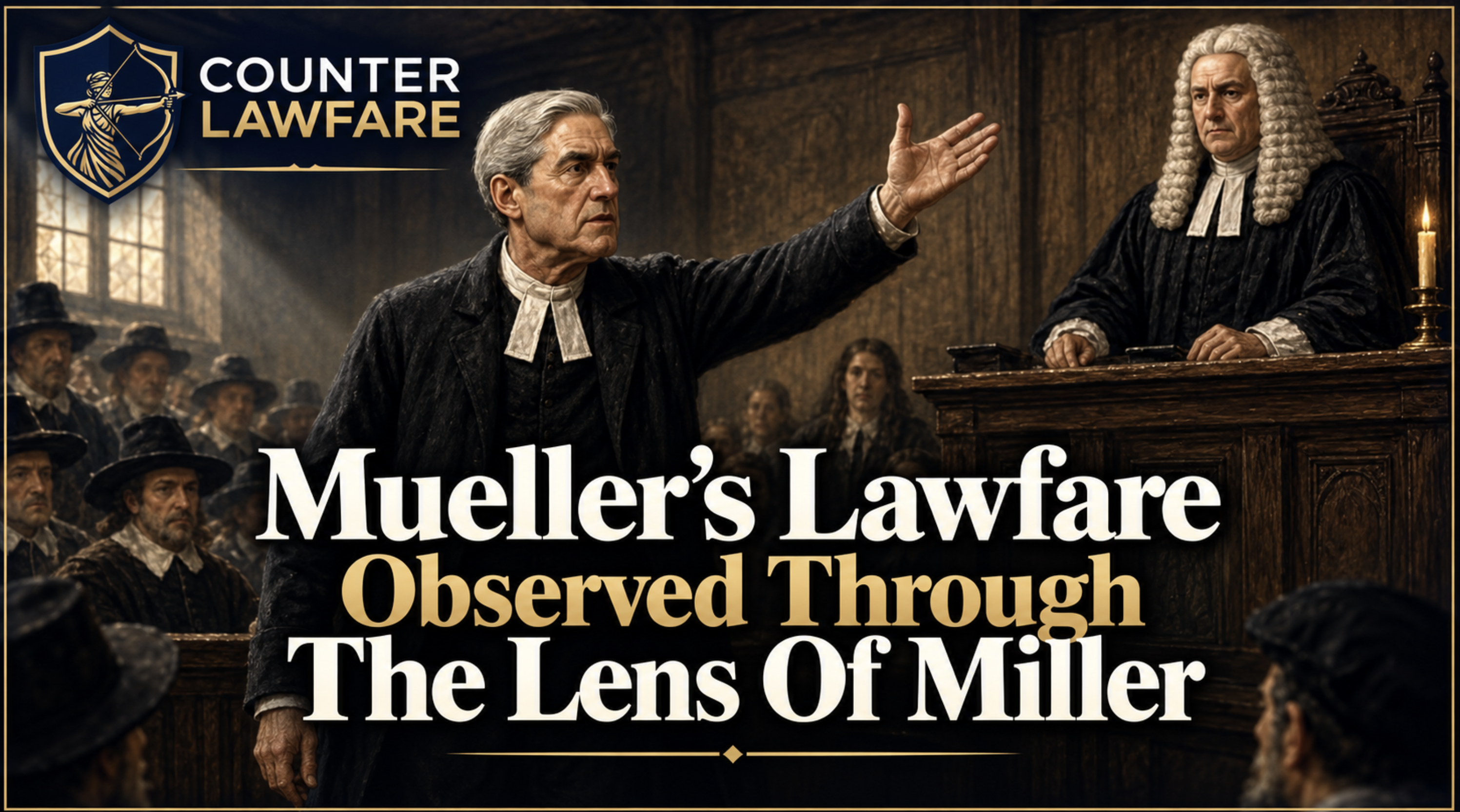
Weight, both literal and metaphorical, is a theme in The Crucible, a play written by Arthur Miller about the Salem Witch Hysteria 1691-1693.
In Act I, Pastor Hale, who claims expertise in identifying witchcraft, arrives in Salem carrying his books on the subject. As Pastor Parris helps him with the books, this exchange occurs:
“Hale: Pray you, someone take these!
Parris, delighted: Mr. Hale! Oh! it’s good to see you again!
Taking some books: My, they’re heavy!
Hale, setting down his books: They must be; they are weighted with authority.”
That exchange contains, in miniature, the entire problem of lawfare. Hale arrives in Salem carrying the gravitas of expertise. He has books, learning, clerical standing, and the confidence of a man who believes that he possesses the specialized knowledge necessary to identify an invisible crime. The machinery ostensibly created to determine whether an accusation is true can itself become the instrument that makes the accusation appear true.
Hale goes on to become deeply involved in the examinations and proceedings that lead to the execution of people accused of something, witchcraft, in which Hale claimed expertise.
In the end, he becomes a prosecution witness in 17 trials that led to executions for a crime that did not exist.
At the other end of Miller’s play, one of those accused of witchcraft, Giles Corey, is pressed to death beneath heavy stones after refusing to enter a plea. His response as more weight was placed upon him was: “More weight.”
He allowed himself to be crushed to death rather than falsely admit to a crime, witchcraft, that he did not commit.
Growing up in the second half of the previous century, my education was proudly called a “Liberal Arts Education.” The English word “Liberal” comes from the Latin “Libertas,” who was the Roman Goddess of Liberty. Libertas’s acolytes were the freed slaves of the Roman Empire. The teachers who taught us how to be Liberal Artists believed that their curriculum would give us the talents to metaphorically be free from influences that enslaved our minds to instinctual modes of coming to a conclusion.
Their first talk explained the three ways that people are convinced of any argument. They were given in the Greek in which they were conceived, but they are easily translated into English. They are:
Pathos: Appeal to listener’s emotion
Ethos: Appeal to speaker’s authority
Logos: Appeal to human reason
Our teachers drew a clear distinction that the appeals to Authority and Emotion were the more primitive pair compared to Logos, the appeal to human reason. One of the old Hippie teachers always bragged about the bumper sticker he had on his Volkswagen Bug: “Question Authority.” He showed us what was called “The Rhetorical Triangle,” and when he did, he made it clear that he thought Appeals to Authority & Emotion are on the bottom on purpose. They appealed to our dark and base instincts.
Our teachers had us read The Crucible to show us what could happen in a society that gives too much credence to the primitive appeal of a speaker’s authority &/or the listener’s emotion and besmirches those who seek truth via human reason. The lesson was clear: people, and sometimes societies, die if people don’t use human reason as a basis for action.
After I left school, the Internet bubble came upon America. The resulting wealth incorrectly convinced people that a Liberal Arts curriculum was dated and schools should focus on a vocational curriculum that centered on Science, Technology, Engineering and Math. Students were not taught to fear being convinced by the Ethos & Pathos persuasion techniques of charlatans like Pastor Hale, nor taught that Giles Corey was someone to emulate.
It is within this zeitgeist that the series of hoaxes that successfully “Swiftboated America” was launched and thrived.
Robert Mueller’s special counsel investigation arrived carrying its own stack of heavy books. It had prosecutors, FBI agents, grand juries, subpoenas, indictments, classified intelligence, breathless press coverage, and the enormous institutional prestige of the Department of Justice. We were told that Mueller represented something definitive, solemn, independent, and almost sacrosanct.
The existence of the investigation became the evidence.
That is what made the Trump Swift Boat Project such a powerful exercise in lawfare. Legal mechanisms that ostensibly existed to investigate the narrative instead helped authenticate it. The circularity was extraordinary. The allegation justified the investigation, while the investigation validated the allegation. It was the same circularity Miller saw in Salem.
And just as in Salem, the consequences were real. Flynn, Stone, Papadopoulos, Page, and many others were subjected to prosecutions, surveillance, investigations, crushing legal costs, and reputational destruction. The machinery that gave the Trump Swift Boat Project its apparent legitimacy also became the means by which its targets were punished.
By the time the Mueller report appeared, the central conspiracy that had justified years of national hysteria was nowhere to be found. Yet a presidency had been consumed by investigation, individuals had been financially and personally devastated, and the country had spent years being told that its political system had been penetrated by a hostile foreign power.
As with Salem, few of those who supplied the authority ever seriously reckoned with what they had done.
The Trump Swift Boat Project & The Salem Witch Hunt unite Americans across epochs. The 1691 and 2016 hoaxers attacked us Americans when we were a country without the rhetorical shields needed to defend us. For generations after the Salem hysteria, it was used as a case study so Americans understood what happens when the malevolent are able to claim false authority.
But because of the polity’s recent obsession with a STEM education, we stopped teaching the lessons of Salem. So when aspiring Pastor Hales saw our shields were down, they exploited their apocryphal gravitas and launched the Kavanaugh rapist hoax, the zoonotic origin of Covid, and that police officers are gunning down thousands of black men. With those successes, they besmirched all those who accurately accused Hunter Biden of taking cash from the Ukraine “for the big guy” as “conspiracy theorists.” This series of hoaxes & hysterias have brought us to the cusp of both World War III and domestic civil strife.
We need to see Robert Mueller through the mind and words of Arthur Miller. It is human reason that brings us together in a peaceful civilization. Yet without it, society’s ties wither like a Massachusetts maple in November.
All is not lost. We do not have to martyr ourselves like Giles Corey. We just need to pick up the rhetorical shields and swords we incorrectly dropped. We then need to engage in the battle for our civilization, using Logos, to remind our fellow citizens that, in the words of Calvin Coolidge, “we are lovers of freedom and anxious for the fray.”
We have to recover the habits of mind that make lawfare harder to execute. Question the premise before accepting the process. Demand evidence before treating an investigation as validation. Distinguish an indictment from proof. Above all, refuse to mistake the weight of authority for the weight of evidence.
Arthur Miller saw Salem reflected in McCarthyism. Our generation has watched the same psychology reappear through the Trump Swift Boat Project, media hysteria, and the political weaponization of legal processes. The names and instruments change, but the underlying mechanism remains remarkably constant.
If America is going to withstand the age of lawfare, rebuilding legal safeguards will be essential. But an intellectual culture that allows citizens to recognize lawfare when they see it is a necessary antecedent to a legal system that provides fair judgment to all.
At the Counterlawfare Institute, we fight the fray with reason, skepticism, and the willingness to question authority, especially when the authority comes armed with the full weight of the state. The moment we allow official power to substitute for evidence, or permit appeals to authority and emotion to overwhelm reason, we invite the return of the stones.
These are the stakes we are fighting for at the Counterlawfare Institute. We invite you to join us as either a donor or volunteer.