
Research
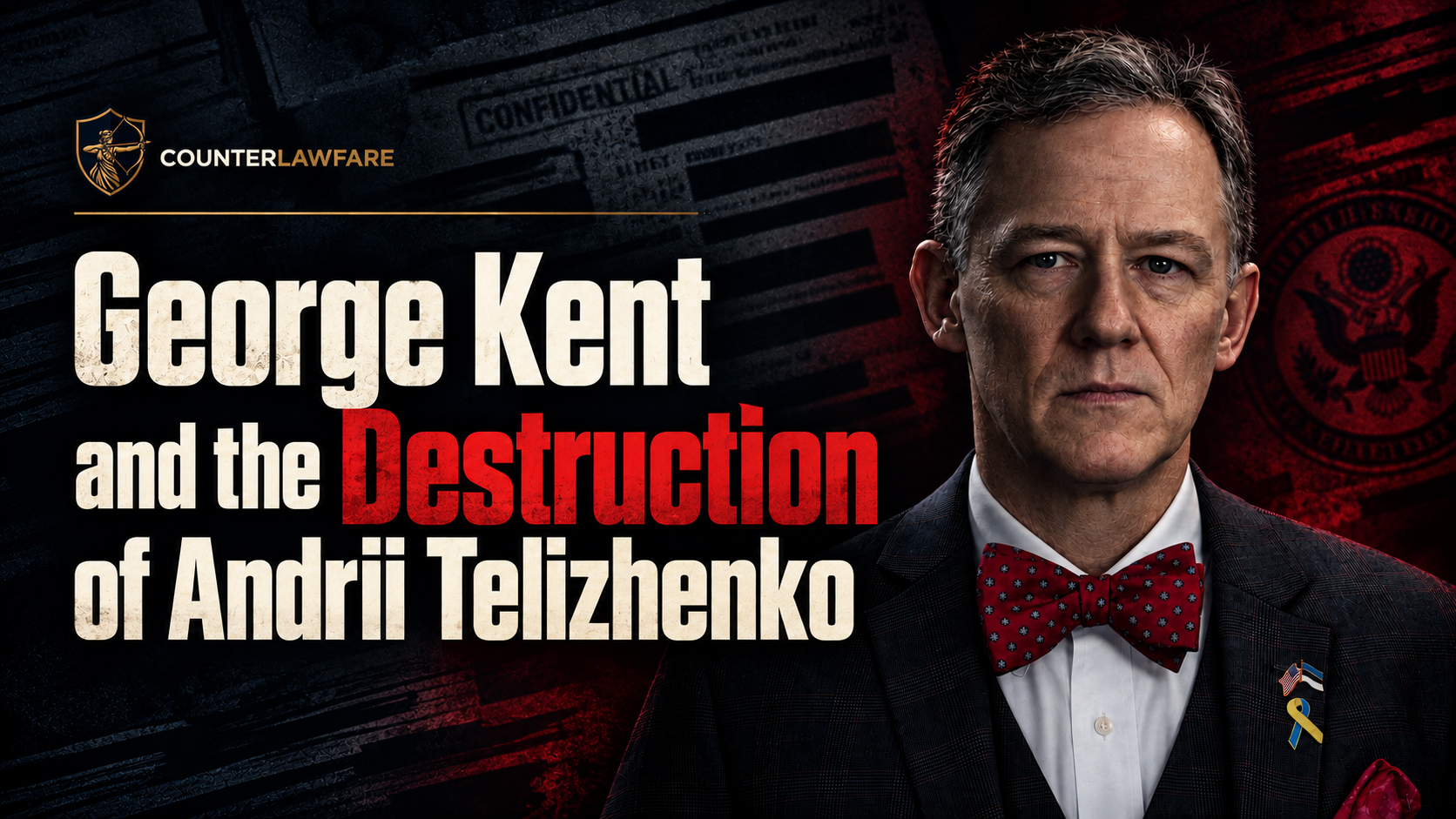
George Kent and the Destruction of Andrii Telizhenko
When the Counterlawfare Institute chose Andrii Telizhenko for our first major interview in July, we did so for a reason. We believed his case was one of the most outrageous examples of lawfare to emerge from the entire Ukraine impeachment saga, and we wanted Americans to hear directly from a man whose life had been systematically destroyed for attempting to expose corruption involving the Biden family.
Now, thanks to newly declassified government documents released through the White House and the efforts of John Solomon, we have documentary confirmation of what Andrii told us.
And at the center of this sordid affair stands one of the principal operatives behind the first impeachment of President Trump, former chargé d’affaires at the U.S. Embassy in Kiev and subsequently the senior State Department official in charge of Ukraine, George Kent.
The central fact of this scandal is as simple as it is appalling. In September 2020, the United States government prevented Andrii Telizhenko from traveling to Washington to provide evidence to Senate investigators examining Biden family corruption, just weeks before the presidential election.
Andrii had firsthand knowledge of Ukrainian government activities, Burisma's dealings with politically connected American intermediaries, and events that could have exposed serious discrepancies in the story presented to the American public during Trump's impeachment.
Some of those discrepancies concerned George Kent himself.
Kent had been a principal witness in the Democrats' impeachment proceedings. He had spent years deeply involved in American policy toward Ukraine and was intimately familiar with the Biden family's entanglements there.
Kent knew perfectly well that Burisma had engaged in corruption and that there were many unanswered questions about the Biden family's Ukrainian dealings, yet he helped advance an impeachment narrative that sought to discredit scrutiny of those dealings.
Kent must have been worried about his own impeachment testimony being discredited when Andrii was preparing to tell Congress what he knew.
On September 8, 2020, the American embassy in Kiev revoked Andrii's visa one day before his planned departure for Washington.
The newly released documents show that the embassy acted in a hurry specifically because Andrii was about to board a plane.
The brazenness is breathtaking. A witness in a congressional investigation was preparing to travel to Washington to provide evidence concerning corruption involving a presidential candidate. Instead of allowing Congress to hear his testimony, American officials in Kiev scrambled to prevent that from happening.
Meanwhile, the FBI was conducting its own disgraceful campaign to discredit investigations into Biden corruption. Its operation known as Round River had gone so far as to characterize Senators Ron Johnson and Chuck Grassley themselves as conduits of Russian disinformation.
But, crucially, in Andrii's case, the decisive action came from the State Department. It was the American embassy in Kiev that pulled the trigger, not the FBI.
At the time, Kent was in charge of Ukraine policy at the State Department. The newly released correspondence exposes his unmistakable hostility toward information that threatened to expose Biden corruption and, in the process, undermine his own testimony during President Trump’s first impeachment.
On October 6, 2020, shortly after Andrii's visa had been revoked, an official whose name has been redacted emailed Kent to say that "there was no basis to revoke his visa beyond some vague ties to Derkach." It is unclear whom the official was referring to, but crucially, Kent replied that "connections to Derkach for anyone planning on coming to the US, less than a month before the election, should be grounds to prudentially revoke."
In other words, even setting aside his own glaring conflicts of interest and self-serving motives, Kent, the senior State Department official responsible for Ukraine, was prepared to exclude people from the United States without a shred of substantiated evidence, simply because what they might reveal could damage Joe Biden ahead of the presidential election.
Then, on October 20, Kent circulated an internal State Department email claiming that Andrii's visa had been revoked immediately before his planned trip to the United States, where he was supposedly going to provide "manufactured case information."
Kent was declaring the evidence of a congressional witness to be fabricated after the State Department had prevented that witness from traveling to Washington.
What possible business did Kent have prejudging evidence that Congress had not even been allowed to hear?
Who appointed Kent the arbiter of which witnesses the United States Senate is allowed to hear?
And how could an official whose own conduct and impeachment testimony were directly implicated in the subject of that investigation be allowed anywhere near a decision that prevented the witness from appearing?
The central issue is whether Kent used the power of the State Department to prevent a witness from giving Congress evidence that threatened Kent himself. If so, this raises the specter of obstruction of a congressional investigation.
And there is another grotesque aspect to this affair.
The American government knew all along that Andrii Telizhenko was no Russian operative. Its own intelligence established that Russia had banned him from entering the country for supporting the 2014 Ukrainian revolution and that, when Russian operatives subsequently reached out to him, he flatly rejected them. The Russians regarded Andrii as an adversary, and American officials had the evidence in black and white. Yet they went ahead and branded him a Russian disinformation operative anyway on the pretext that Andrii made a brief appearance in a documentary produced by Michael Caputo, a Trump administration official.
Those accusations became the justification for preventing him from testifying before Congress, followed by the even more devastating punishment of sanctions imposed in January 2021.
Andrii has never been charged with a crime. Nevertheless, the sanctions have effectively destroyed his ability to lead a normal life.
The most urgent question now is how an American government that has publicly exposed such a disgrace can continue enforcing the sanctions that resulted from it.
As far as George Kent is concerned, his role in preventing a witness from reaching Congress must be subjected to a full public accounting. If a senior American official used the machinery of government to suppress congressional testimony that could have implicated his own conduct, it would constitute an abuse of power of the highest order.
About the Author